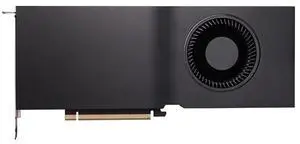
The professional GPU market has a category nobody markets to. Not the consumer-Hardware Unboxed crowd. Not the enterprise-procurement teams buying H100s by the rack. The serious independent — the engineer at a small studio, the architect running Revit and Twinmotion, the freelance VFX artist who needs ECC memory because client deliveries can't have bit-flips — pays for that gap. NVIDIA's RTX A4500 sat in that gap for three years. It's now $1,479 on Newegg's first-party listings, 34% off its launch price, and quietly one of the best buys in the workstation segment.
The Drop
RTX A4500, Ampere generation, GA102 silicon (the same die as a 3090), 7,168 CUDA cores, 224 Tensor cores, 56 RT cores, 20GB of GDDR6 with ECC, a 200W power draw and a single 8-pin connector, blower-style cooler designed to live in a workstation chassis with neighbors. Launch was Q1 2022 at $2,250. Today's listing is $1,479. The discount isn't theatrical — workstation GPUs don't move on impulse — but the 34% number understates the value because the relevant comparison isn't the launch price. It's the current generation.
Why Now
Ada Generation RTX A-series cards (renamed to RTX 4000 SFF, RTX 4500, RTX 5500, RTX 6000) launched in 2023 and built out through 2024. The Ada RTX 4500 — the direct successor to the A4500 — runs about $2,800 new, with 24GB of GDDR6 ECC and meaningful gains in OptiX ray-tracing throughput. Blackwell-generation RTX PRO cards started appearing in volume through 2025; the RTX PRO 5000 Blackwell sits at $4,500 and the PRO 6000 at $8,500. The market has lapped the A4500 twice over.
For the buyer whose budget is $1,500-ish and whose workload is the kind that benefits from ECC and OptiX but doesn't require the latest Blackwell tensor cores, the A4500 sits in an interesting spot. It's not a refurb. It's a current-channel new-condition listing of a card that the market has moved past. The buying audience is small enough that NVIDIA's authorized distributors clear inventory at $1,479 instead of $2,250, but the chip itself is still in active driver support and still receives Studio Driver branch updates.
What It Replaces
Compared to a consumer 3090 — same GA102 die, similar core count — the A4500 trades 18% of the raw FP32 throughput for ECC memory, certified-application driver branches, multi-card vGPU support, a quieter blower cooler designed for desk-side workstations, and a service-and-warranty structure that AutoCAD and Solidworks reseller channels actually honor. For most independents that's a worse trade than buying a used 3090 at $700. For independents whose insurance underwriter or client contract requires "ISV-certified" hardware, it's the only trade available.
ECC and certified drivers don't matter until they do. Then they're the whole product.
The wider context: NVIDIA's RTX 4000 SFF Ada and the A4500 cover most of the same workloads, but the 4000 SFF only ships with 20GB max and is a single-slot card with thermal headroom that limits sustained workloads. The A4500 is dual-slot, blower-cooled, and runs at the full 200W envelope indefinitely. For someone doing eight-hour OptiX renders or extended Twinmotion sessions, that's a real difference.
The Wider Market
Workstation GPU discounting is structural in a way consumer discounting isn't. The professional cycle is two generations behind on retail price — when the Blackwell PRO cards become the current generation, Ada cards drop into the 30-40% off range, and Ampere cards drop into the 30-50% range. That's where the A4500 sits now. The next step down would be the A4000 (16GB, ECC, single-slot) which is still listed around $850-$1,000 and quietly the best-value-per-watt card in the entire NVIDIA stack for someone with a modest CAD workload.
For local-AI builders, the comparison shifts. The A4500's 20GB of ECC VRAM means it'll comfortably run 13B-parameter models in FP16 and 30B-parameter models in 4-bit quantization. The catch is that for pure LLM inference, the consumer 3090 at $700 used gives you 24GB of (non-ECC) VRAM and equivalent token throughput. ECC matters less when the model is the source of error and the workload is throwaway tokens.
What To Watch Next
The signal: when Ada-generation RTX 4500 cards start showing 30%+ discounts off their $2,800 sticker, the A4500's floor moves. That probably starts in Q3 of 2026 as the Blackwell PRO line saturates the enterprise refresh cycle. Until then, the A4500 at $1,479 is the right price for what the card is — a competent, ECC-equipped workstation GPU with two years of driver and warranty support left in it.
The professional GPU market rewards patience. The card the marketing forgot is often the card that pays back the longest.
If you're shopping: Newegg's first-party RTX A4500 listings include the standard NVIDIA three-year limited warranty (not the partner-board one-year) and ship in retail packaging. The price tracks across PNY, Leadtek, and ELSA variants — the silicon is identical, the cooler and packaging differ only cosmetically. The blower direction matters if your workstation case has front-to-back airflow expectations; verify before adding to a small-form-factor build.