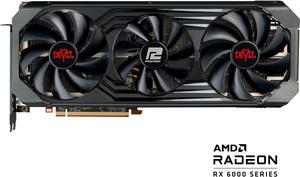
The RX 6950 XT was AMD's stake in the ground in mid-2022 — the high-clock RDNA2 refresh that pushed the chip past 2.3GHz boost and made the 3090's price tag look indefensible. It was Radeon's most coherent generation in a decade. Today, PowerColor's Red Devil variant — refurbished, with the original triple-fan cooler — sits at $489 on Newegg. That's 55% off the launch MSRP. It's also more interesting than the discount makes it look.
The Drop
PowerColor Red Devil 6950 XT, 16GB GDDR6, 80 compute units, 2310MHz game clock, 2435MHz boost, 335W board power, three 8-pin connectors and the long version of the heatsink everybody asked for. New, this card was $1,099 in summer of 2022. The MERC variant from XFX is sitting next to it at $469. The reference 6900 XT (a less-binned version of the same silicon) is at $469 too. Across the refurb pages, the last-generation flagship Radeon stack is at half its launch sticker.
A card that beat the 3090 in raster the year it launched is now cheaper than a single AAA game release window's worth of next-gen GPU.
Why Now
Two things converged. The first is straightforward: Navi 31 (the RX 7900 XTX) and now Navi 41 (RX 8900 XTX, in volume since late 2025) have moved the high-end conversation forward two generations. The 6950 XT is two architectures behind. The second is less obvious. The 6950 XT was always more of a production card than a flagship one — its margins for AMD were narrow, the launch supply was deep, and a lot of the boards never sold through at full price. By late 2024 the channel was carrying inventory it didn't have a customer for. Refurb cycles in 2025 absorbed the open-box and warranty returns. What's left now is the long tail.
There's a third reason that's harder to talk about: RDNA2's reputation didn't survive the FSR-vs-DLSS arc. NVIDIA's DLSS 3.5 ray reconstruction landed in late 2023. By the time DLSS 4 frame generation became a default checkbox in major engines, the 6950 XT's headline advantage — raster perf parity with the 3090 — mattered less. AMD's FSR 3 and FSR 4 closed the upscaling gap, but never reached the brand position that DLSS holds in the enthusiast conversation. The 6950 XT is a great card. It's not a great story anymore. Discount cards sell on stories.
What It Replaces
At $489, the question is: what is this actually a good buy for? The honest answer in late 2026 is 1440p high-refresh raster gaming in a budget that doesn't include the latest path-traced titles. The 16GB of VRAM is the load-bearing spec — modern texture-heavy games are starting to make 8GB and 10GB cards stutter at 1440p, and the 6950 XT has the headroom that the 10GB 3080 doesn't. For a buyer building a new rig at $1,200 total, it's the most pixels-per-dollar in the new-and-warranted market by a margin.
For local-AI hobbyists, the picture is more complicated. ROCm support on Windows is still a work-in-progress in 2026, though significantly better than the 2023 state of things. Linux + ROCm + a 16GB Radeon will run a 13B-parameter model at usable token rates, but the documentation gaps and the dependency-pinning fragility mean it's a different commitment than the equivalent NVIDIA setup. If you're a tinkerer who enjoys the path, it's a real path. If you want the model to run when you hit `ollama serve`, an RTX 3090 used at $700 is still the calmer choice.
The Wider Market
The 6950 XT is the first card down. The 6900 XT (essentially the same chip, less binned) is right behind it. The 6800 XT will follow. RDNA2 as a generation is in the final clearance lap, and the floor under it is probably around $400 for the 6950 XT and $350 for the 6800 XT before resellers stop carrying them. NVIDIA's 30-series refurbs are tracking a similar curve — RTX 3080 at $439, 3090 at $700-ish — but anchored by the brand premium that keeps NVIDIA refurb floors 15-20% above AMD's at equivalent generation.
The signal worth watching is the 7900 XTX. When that card starts seeing its own 35-40% refurb discounts, the 6950 XT discount becomes structural — there's no upgrade in the same generation, only the next one. We're not there yet, but the curve points there for 2027.
Last-generation flagships at half-price are how the GPU market resets the bottom of its ladder.
What To Watch Next
If you're shopping a 6950 XT: refurbished from Newegg's first-party listings carries a 30-day return and a one-year limited warranty on most third-party board partner cards. PowerColor and XFX are the safer pick over Sapphire and ASRock at this generation — the Red Devil and MERC coolers were engineered for the silicon's thermal profile, and the warranty support reads cleaner. Avoid open-box listings that don't specify "refurbished" — those skipped the bench-test cycle.
The deal is good. It's also a closing chapter, not an opening one. Buy it for what it is — a competent 1440p card with VRAM headroom for the next two years of games — and not for what the launch reviews said it would be.