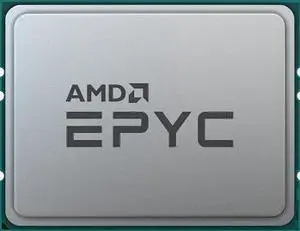
There's a particular kind of price drop that doesn't mean what people think it means. The EPYC 9654 — the 96-core, 128-PCIe-lane chip AMD launched at $11,805 to take the data-center crown away from Sapphire Rapids — is now sitting on Newegg's clearance page at $3,000. A 75% strike. The chip itself hasn't changed. The market under it has.
When a flagship server CPU drops three-quarters off MSRP in eighteen months, the chip is rarely the story.
The Drop
EPYC 9654 was the announcement that ended the enterprise-Intel conversation in late 2022. 96 Zen 4 cores at 2.4GHz base, boost to 3.7GHz, twelve channels of DDR5-4800, 128 lanes of PCIe Gen5, and a TDP that climbs into the 400W envelope under sustained AVX-512 load. It was the chip you bought if you were building a dense, memory-bandwidth-bound workload and didn't want to apologize. It was also the chip with which AMD finally won the server-revenue ratio nobody thought they'd reach this decade.
Today, Newegg is selling refurbished trays — vendor-unlocked, no platform restriction — at $3,000. That's not a clearance discount on a slow-moving SKU. That's an entire generation of silicon being moved off the books while the next one walks in.
Why Now
The simplest explanation is the most accurate one: the customers who needed 96 Zen 4 cores already have them. Cloud build-outs in 2023 and 2024 absorbed the first two production cycles of Genoa. The hyperscalers got their allocations, the colocation buyers picked up their second wave, and the enterprises who said no to Sapphire Rapids said yes to this. By mid-2025, Turin (Zen 5, up to 192 cores) was sampling in volume to the same accounts. By the end of that year, the Zen 5 EPYC 9005 series was generally available and the question for any refresh cycle was no longer "9654 or 8480?" — it was "9654 or 9655?"
The Zen 5 EPYC 9655 has more cores, more cache, a refined IOD, and a power profile that's flatter under realistic mixed workloads. It also costs more. The customers who don't need the bleeding edge — the ones running databases that already saturate twelve channels of DDR5, or VMware estates where vCPU count matters more than per-thread peak — are the ones buying these refurbs at $3,000. They're not getting the latest generation. They're getting the previous flagship for a quarter of its sticker price, and that math closes a lot of capex requests.
What It Replaces
Drop in a single 9654 and you get 96 cores of Zen 4 silicon for the price of two consumer Threadripper 7980Xs. Per-core, that's roughly $31. The closest current-generation comparison is the EPYC 9554 — 64 cores at retail of $7,500-ish, or about $117 per core. The gap is wider than it should be, and it's wider because nobody is buying 9554s when 9654s are sitting in this stack.
The other interpretation is the AI one. Through 2024 and into 2025, hyperscalers reallocated CapEx away from generic CPU compute and toward GPU and accelerator clusters. The narrative the analyst class likes — "AI compute is eating everything" — has a parts-bin corollary: the other parts of every data-center order shrink to fund the GPU half. Memory, storage, networking, and yes, host CPUs. The 9654 wasn't supposed to be a discounted chip in 2026. It became one because the customers who used to buy four of them now buy two, and the rest of the line-item rolls back to the resellers.
The Wider Market
The pattern repeats below the 9654. The 7763 — 64 Zen 3 cores, the chip that earned AMD's server line its credibility — is at $1,545 refurbished, against an $7,890 launch price. The 7713, same generation, 225W lower-power variant, $1,580. The 7443, 24 cores, $440 against a $2,010 launch. Across the Milan and Genoa product stacks, the strike-through average is sitting between 70% and 80% off MSRP. That's not noise. That's a generation being aggressively cleared while AMD's enterprise narrative pivots entirely to MI300 and Turin.
For an AI workstation builder running a homelab — a buyer who needs many cores and many memory channels but has no requirement to be on the current generation — these are the most cost-efficient enterprise CPUs ever sold. A dual-socket SP3 board, two 7763s, eight channels of DDR4-3200, and the whole rig is under $4,000 with second-hand parts. That kind of compute, at that price point, didn't exist in any previous cycle.
The AI compute land grab created a discount aisle most people didn't notice was there.
What To Watch Next
The first wave of Turin clearance is the obvious tell. When the EPYC 9655s start landing on refurb pages with their own strike-throughs, the cycle is closed and the 9654 floor moves down again. That probably starts in 2027 once Zen 6 reaches enterprise. Before then, the 9654 at $3,000 may already be the floor — there's a limit to how cheap a fully-functional 96-core flagship can be sold for before the resellers stop sourcing them.
If you're shopping: refurbished EPYC parts from Newegg's first-party listings carry standard 30-day return windows and the vendor-unlocked stock is the important variant — chips marked "VENDOR LOCKED" came out of Dell or HPE chassis and won't post on third-party boards. The $3,000 listings we're tracking are the unlocked stack.
The chip didn't change. The math did.